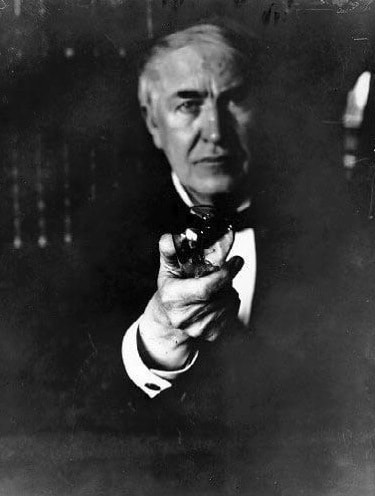
 THOMAS EDISON, U.S. INVENTORThis is one of the best statements ever on the ease and legitimacy of the government creating its own money.
“If our nation can issue a dollar bond, it can issue a dollar bill. The element that makes the bond good makes the bill good… If the Government issues bonds, the brokers will sell them. The bonds will be negotiable; they will be considered as gilt edged paper. Why? Because the government is behind them, but who is behind the Government? The people. Therefore it is the people who constitute the basis of Government credit. Why then cannot the people have the benefit of their own gilt-edged credit by receiving non-interest bearing currency… instead of the bankers receiving the benefit of the people’s credit in interest-bearing bonds?”
1 Comment
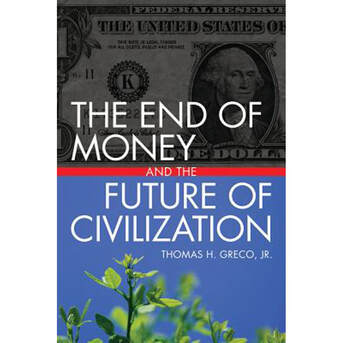 THE END OF MONEY AND THE FUTURE OF CIVILIZATION
“The money problem can be summarized thusly: the way in which money is created by the banking system today causes a debt imperative which drives a growth imperative -- this forces destructive competition for the available supply of money, which is never sufficient to enable all debtors to pay what they owe…. “The evils that have been spawned by the collusion between political power and financial power are far worse even than those that arose from the collusion between political power and religious power… “When the realization of the inherent money power in all of us comes to man he will…push down the walls of his prison. Finance which is the creature of the unholy wedlock between banker and state cannot be solved by either power dominating the other. The only solution lies in the people denying the power of both over industry and their assertion of their own money power… THOMAS GRECO, MONETARY REFORMER https://www.wikiwand.com/en/Thomas_H._Greco_Jr.
https://www.linkedin.com/pulse/we-build-road-travel-scaffolding-new-economy-built-learn-piestrak/
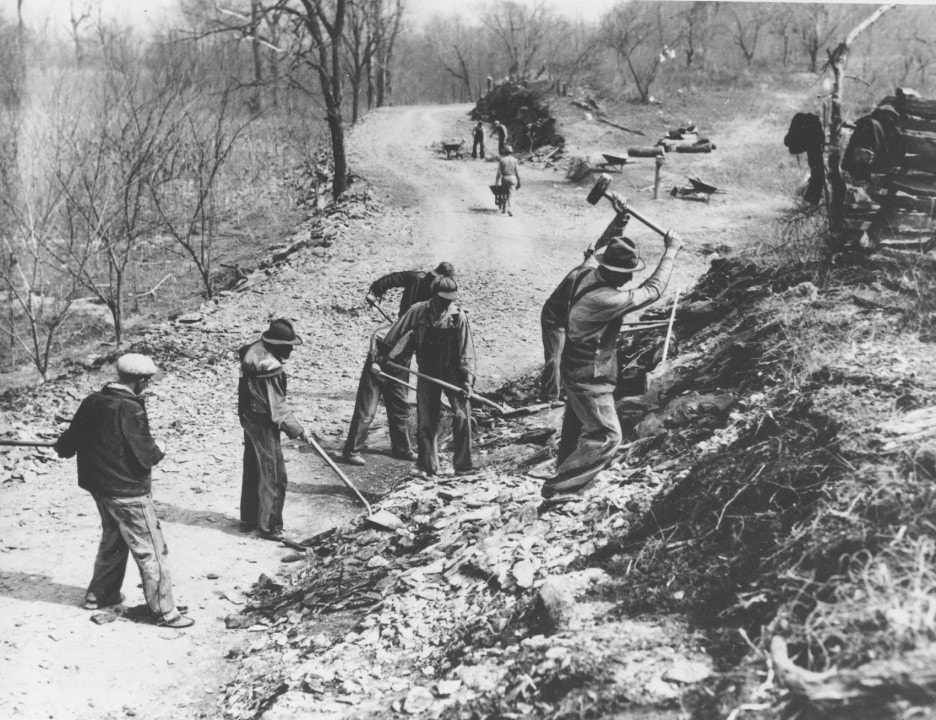
Works Progress Administration workers build a new farm-to-market road along Knob Creek in Tennessee, March 9, 1936. (AP Photo)
A Post by Jeff Piestrak Public Services at Albert R. Mann Library, Cornell University
Like Nick Hanauer, proclaiming ‘Homo Economicus’ Must Die: "The last 40 years of research across multiple scientific disciplines has proven, with certainty, that homo economicus does not exist. Outside of economic models, this is simply not how real humans behave.... Being rapacious doesn’t make you a capitalist. It makes you an asshole and a sociopath. In an economy dependent on complex trust networks to facilitate the cooperative tasks from which prosperity emerges, and when prosperity itself is understood—not as money but as solutions to human problems—true capitalists understand that every economic act is an explicitly moral choice—and they act accordingly." The Values of Economists are not the Values of SocietyChristian Felber of the Common Good Economy speaks with Renegade Inc on the disconnect between our values enshrined in constitutions around the world and the antithetical set of values propagated by mainstream economists are falsely represented as immutable natural systems - not simply the propaganda of special interest groups that benefit from maintaining the current operating system - despite these jarring contradictions.
A short introduction to "our" money system, why our money system choice matters, and why changing to a Just Money system can make it possible to pay for a better world.
Talk about Positive Money
Ben is the founder of Positive Money, a campaign for a banking system that works for society and not against it. At Meaning 2014 he got into the nitty gritty of how the current process for money creation is causing a rise in poverty, instability and inequality. And challenged the audience to imagine what a modern and sustainable system could look like. The Meaning conference is an annual gathering for people who believe business can and must be better in the 21st century. Professor Richard Werner, interest rates do not drive the economy.
Professor Werner talks about the empirical study he made about nominal interest rates and economic growth. The facts suggest clearly that interest rates do not drive the economy and they are not negatively correlated. This would mean that monetary policy, as used by central banks, would, at best, be very ineffective. Professor Richard A. Werner holds a First Class Honours B.Sc. in Economics from the London School of Economics and a doctorate in Economics from the University of Oxford. He has also studied at the University of Tokyo. Richard is a Member of Linacre College, Oxford, and is a university professor in banking and finance. He is also a founding chair of Local First, a community interest company establishing not-for-profit community banks in the UK (including the Hampshire Community Bank). Until February 2019, Richard was for many years a member of the ECB Shadow Council. His work experience includes: chief economist at Jardine Fleming Securities (Asia) Ltd., a stint as Senior Managing Director at Bear Stearns Asset Management Ltd., many years managing global macro funds, several years as senior consultant to the Asian Development Bank and periods as visiting scholar and visiting researcher at the Japanese Ministry of Finance and the Bank of Japan, respectively. His book ‘Princes of the Yen’ was a No. 1 bestseller in Japan, beating Harry Potter for six weeks.
|
The Decentralist(Re)localizing is the best path to decentralization and taking back our agency in the political economy. Archives
October 2022
Categories |
 RSS Feed